Work focus · the undercurrent
Executive function: the undercurrent
My main focus at work right now is executive function skills — the quiet mental machinery underneath every school task and, honestly, underneath every life task. This page is where that work lives.
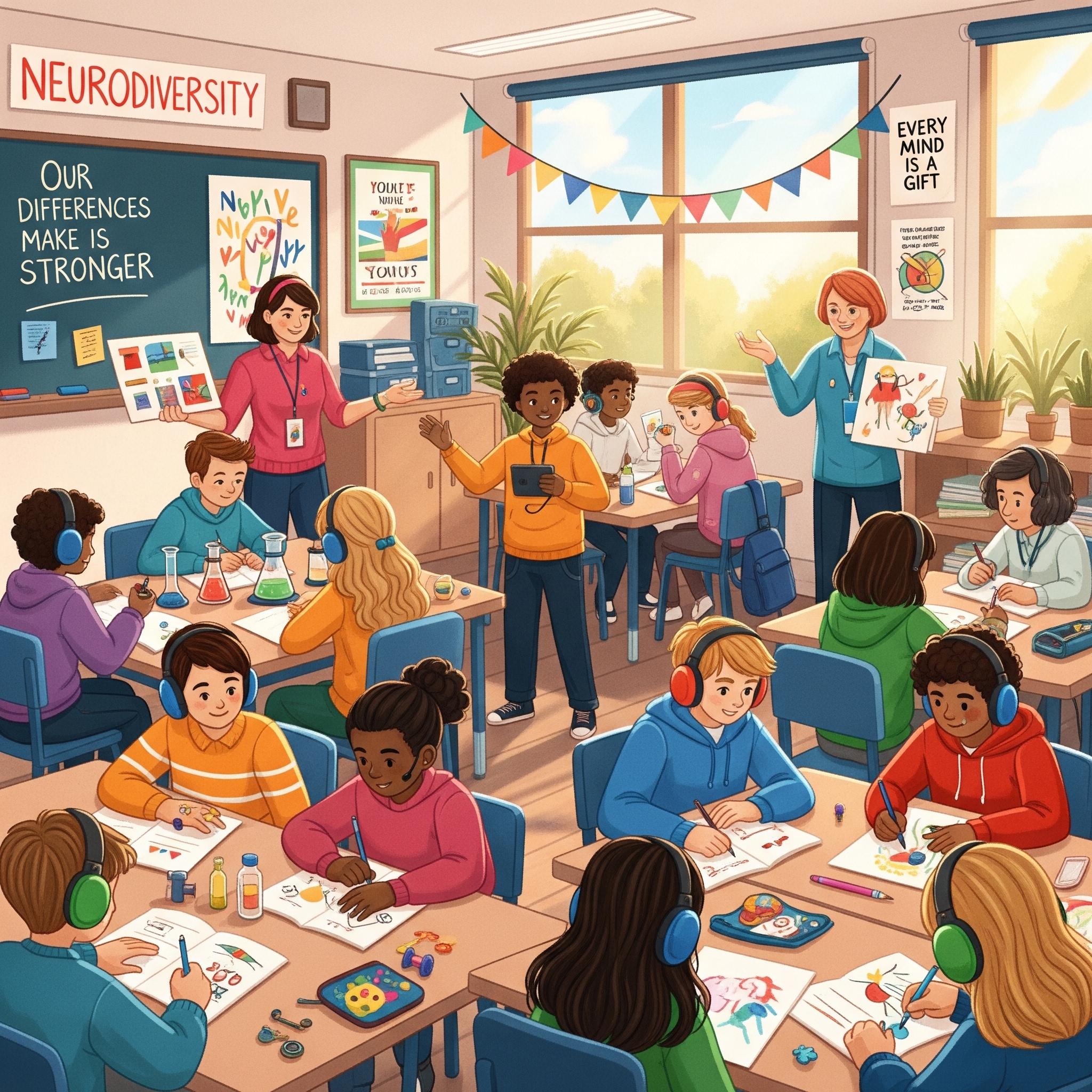
This work follows the framework of Emily Bartz, a learning specialist at Friends School of Baltimore, whose approach to executive function is grounded in the executive skills research of Peg Dawson and Richard Guare. Her premise is the one I have built my own practice on: EF is not a program to implement or a buzzword to survive. It is a shared lens — a way of reading student behavior as skill development in context rather than as character.
I
Foundational to all of life
Executive function skills are the skills we use to manage ourselves and our work: starting a task, holding information in mind while we use it, planning, organizing, managing time, shifting approach when something is not working, regulating emotion, and seeing a thing through to the end. Schools tend to treat these as study skills — something between a chore chart and a detention. They are not. They are the foundation under all of life's activities: keeping a job, keeping a friendship, keeping a household, keeping a promise to yourself.
That is why I push back on the framing that EF support is remediation. A student who cannot yet start a task on demand is not broken, and a student who can is not virtuous. These are skills, which means they are built — and they are built later in some brains than in others, on a timeline that has nothing to do with intelligence or effort. The prefrontal cortex is under construction into the mid-twenties. Adolescence is not a failure to have arrived; it is the construction site itself.
For neurodivergent students — and for many students carrying load that has nothing to do with a diagnosis — the gap between what they understand and what they can execute is the central frustration of school. They know the material. They cannot get the essay started, cannot find the worksheet, cannot feel time passing. Treating that gap as a character flaw is one of the quiet cruelties of schooling. Treating it as a skill gap is the beginning of actually helping.
II
An undercurrent, not a unit
EF skills are not a unit I teach in October and finish by Thanksgiving. They are an undercurrent in everything I do — in how I structure an assignment, how I open a class period, how I read a student who is staring at a blank page. Emily Bartz calls the shift putting on your perspecticules — perspective plus spectacles: a lens that moves a teacher from reacting to behavior to interpreting it as skill development in context. Once you wear them, you cannot take them off. The student who is 'lazy' becomes a student whose task initiation is underwater. The student who is 'careless' becomes a student whose working memory dropped the second step.
The undercurrent runs under my research too. The belonging question and the EF question are the same question at different depths: both ask whether the school's structure assumes capacities that some students are still building, and both ask who pays when the assumption is wrong. A school can welcome a student warmly and still hand them a planner system designed for a brain that is not theirs. Belonging that stops at the door and never reaches the homework load is welcome without scaffold — one wall of the blueprint standing alone.
III
I study systems — and this is one
I study systems. It is how my mind works: I want to know how the parts connect, where the load travels, what breaks first under stress. Executive function is a system — not a trait, not a talent, but an interlocking set of processes that either holds a student's day together or doesn't. And because it is a system, it can be scaffolded like one: deliberately, structurally, with the scaffold designed to come down.
That systems view changes what support means. You do not fix a system by telling it to try harder. You look at where the friction actually is — the start, the middle, the handoff between steps — and you build structure at exactly that point. Then you watch, and adjust, and hand the structure over piece by piece. The scaffold is not the goal. The student's own system is the goal.
IV
LEC workshop: where the scaffolding happens
The Learning Engagement Center workshop — our supervised study skills class and study hall — is where this stops being theory for me. LEC is the room where the scaffolding is the curriculum: we are not only helping students get tonight's homework done, we are building the executive function system that tonight's homework happens to be exercising. Task initiation, planning, organization, time management, self-monitoring — practiced on real work, in real time, with an adult who is watching the system rather than just the assignment.
This is the part of my job I want to keep getting better at, because the stakes are quiet and high. A supervised study hall can be a place where students are parked, or it can be the one hour in the day where someone is deliberately teaching the skills every other hour assumes. I want it to be the second thing. I have also written elsewhere on this site about the uncomfortable language around LEC — how students who choose optional help announce that they are 'not in LEC,' and how required support gets read as the irregular study hall. The EF lens is part of my answer to that stigma: these skills are not a verdict on a student. They are the construction every brain is still doing.
V
The goal: students build their own systems
The point of all of it is handover. Students need to develop their own systems for managing their executive function skills — not my system, laminated and handed down, but theirs: the planner they will actually open, the starting ritual that works for their brain, the way of breaking a project into pieces that they arrived at and therefore trust. A scaffold that never comes down is not a scaffold; it is a dependency with good intentions.
So the arc of the work is: name the skill, build the structure together, practice it on real tasks, then deliberately transfer ownership. The student learns to notice their own friction points — I cannot start, I lose the middle, I never see the deadline coming — and to reach for a tool they have tested rather than a verdict about themselves. That is what I want a student to carry out of LEC: not a finished system, but the knowledge that they are a person who builds systems. That sentence, believed, is worth more than any planner I could hand them.
The framework and where it comes from
The EF skills framework I use follows the work of Emily Bartz, learning specialist at Friends School of Baltimore, grounded in Peg Dawson and Richard Guare's executive skills research. Her EF profile quizzes — the student checker I use with high school students, and the teacher/adult version — live on her own site, EFs with EB; the direct links are below alongside her recent writing.
- EFs with EB — Emily Bartz's site →
Learning specialist at Friends School of Baltimore. Her site holds the EF profile framework, the student checkers, and classroom resources; she also presents on executive function as a shared lens for schools (NAIS Thrive, with Heidi Hutchison).
- Student EF Checker (ages 11–18) →
Bartz's EF profile snapshot — the quiz students take to see their own EF strengths and friction points. This is the one I use with high school students.
- Teacher / Adult EF Checker →
The same lens turned back on us. Bartz's EF profile snapshot for teachers and other adults — worth taking before asking a student to name their own friction points, because it shows which executive demands an adult naturally over-supports and which ones quietly get handed to the student instead.
- Education Week: 7 ways to teach impulse control (featuring Bartz) →
October 2026 — Bartz's strategies alongside Peg Dawson's, on response inhibition, flexibility, and emotional control.