EDOC 7120 · Global Histories and Politics in EducationFall 2026 · Week 6
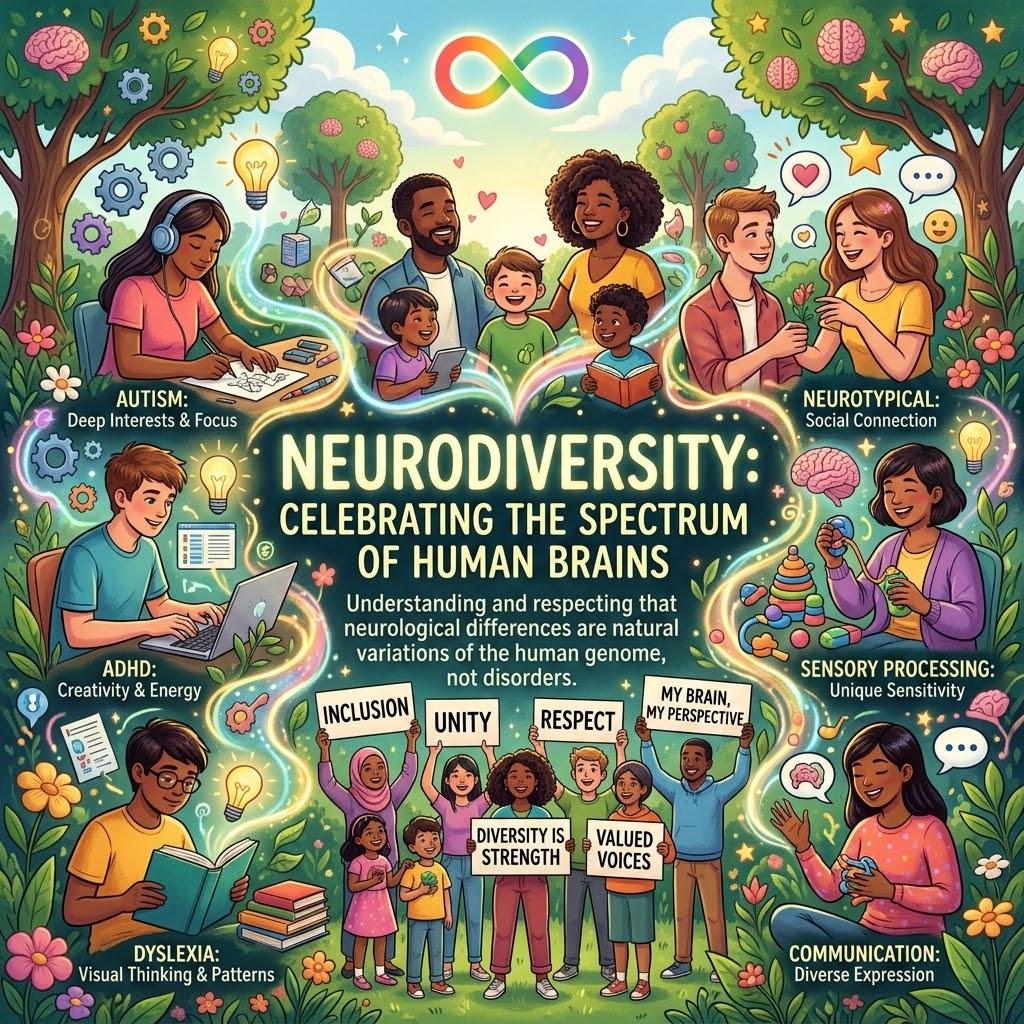
History and Evolution of Neurodiversity as a Concept and Political Tool
A co-presentation with Diana Gaukel tracing neurodiversity from 18th-century institutionalization through Buck v. Bell, IDEA, and the self-advocacy movement, into decolonizing critiques and present-day school practice — closing with positionality and a norms exercise for the room.
Watch the recorded presentation — first draft (Loom)What I learned
That the history of neurodiversity is a history of who held the pen. Clinicians named the defect; advocates named the variation. Once I saw the sequence, I could not read a referral form the same way.
What I would change now
I would open with the Global South paradigm instead of arriving at it in the final third. Structuring the deck as North-then-critique quietly reproduced the centering I was trying to name.
How it connects
It converted my belonging work from a question about school culture into a question about whose neurology the culture was designed around — and it gave me critical disability theory as a frame.
Organizational Culture & ChangeFall 2025
Culture audit of a middle school
A semester-long audit mapping the stated values of one building against its observable routines, using documents, schedules, and three staff interviews.
Final audit report (PDF)What I learned
That the gap between a school's stated values and its calendar is the most reliable diagnostic instrument I have found.
What I would change now
I would interview students. I audited a school's culture without asking the people who live in it most.
How it connects
Directly feeds the belonging-as-infrastructure framework and the question about whose expertise counts.
Research DesignWinter 2026
Methods memo: studying a moving target
A design memo arguing for repeated light-touch qualitative observation over a single instrument, with a proposed semester-long protocol.
Design memo (PDF)What I learned
How to defend a method on the grounds of what the phenomenon is, rather than what is convenient to collect.
What I would change now
The sampling section is hand-waving. I would rewrite it with a real recruitment plan.
How it connects
The working answer to the open question about studying something that moves.
Field Experience SeminarWinter 2026
Field observation set: transitions
Five days of structured observation of passing periods, coded for interruption rights, greeting patterns, and route choice.
What I learned
That my coding scheme changed on day three, and that the change was the finding rather than a flaw.
What I would change now
I would keep both coding schemes and analyze the difference between them.
How it connects
The origin of the unowned-four-minutes research idea.