Dissertation · first draft
Counterstorytelling, belonging, and academic achievement
A developing study of neurodivergent BIPOC students’ academic and belonging experiences in a diversifying private school: listening to students’ accounts alongside a proposed examination of MAP growth data. The paper and recorded proposal mark the starting point, not a finished design.

01
The direction of the study
My professor helped me narrow a title that was too broad. The current center is BIPOC students at the intersection of neurodiversity and other dimensions of identity, their sense of belonging at my school, and their academic experiences and achievement. I want to understand how the school’s expectations, relationships, and support systems meet those intersections.
The first draft and presentation describe a counterstorytelling analysis of neurodivergent BIPOC students’ academic and belonging experiences. They also raise a second strand: examining MAP growth over time alongside student experience. Racialized rigor remains a possible interpretive concept within that work; it is no longer the entire study.
The title and design are still developing. The paper uses both “narrative inquiry” and “mixed methods,” and its MAP analysis section is still to be written. This page follows that direction without presenting those choices as settled.
The study also has a constructive destination I have started calling a blueprint of belonging: a study-derived, buildable plan for how a predominantly white private school welcomes, supports, scaffolds, and retains its BIPOC and marginalized students — including neurodivergent students and students marginalized for gender identity or any other way they are placed outside the “bubble of normalcy.” Racialized rigor names the problem and micro-assumptions names the mechanism; the blueprint is what the findings are for. The phrase is not mine to coin — Morgane Michael published A Blueprint for Belonging (Solution Tree, 2024), and variations appear across the literature — so I use it with attribution. The contribution is the construct: study-derived, school-specific, and checkable against the actual building.
Student experience
Counterstories about belonging, support, expectations, identity, and academic life.
Academic growth
A proposed longitudinal examination of MAP growth—not yet collected or analyzed for this study.
The connection
How students’ accounts and growth patterns might inform one another, including where they do not agree.
02
Problem and purpose
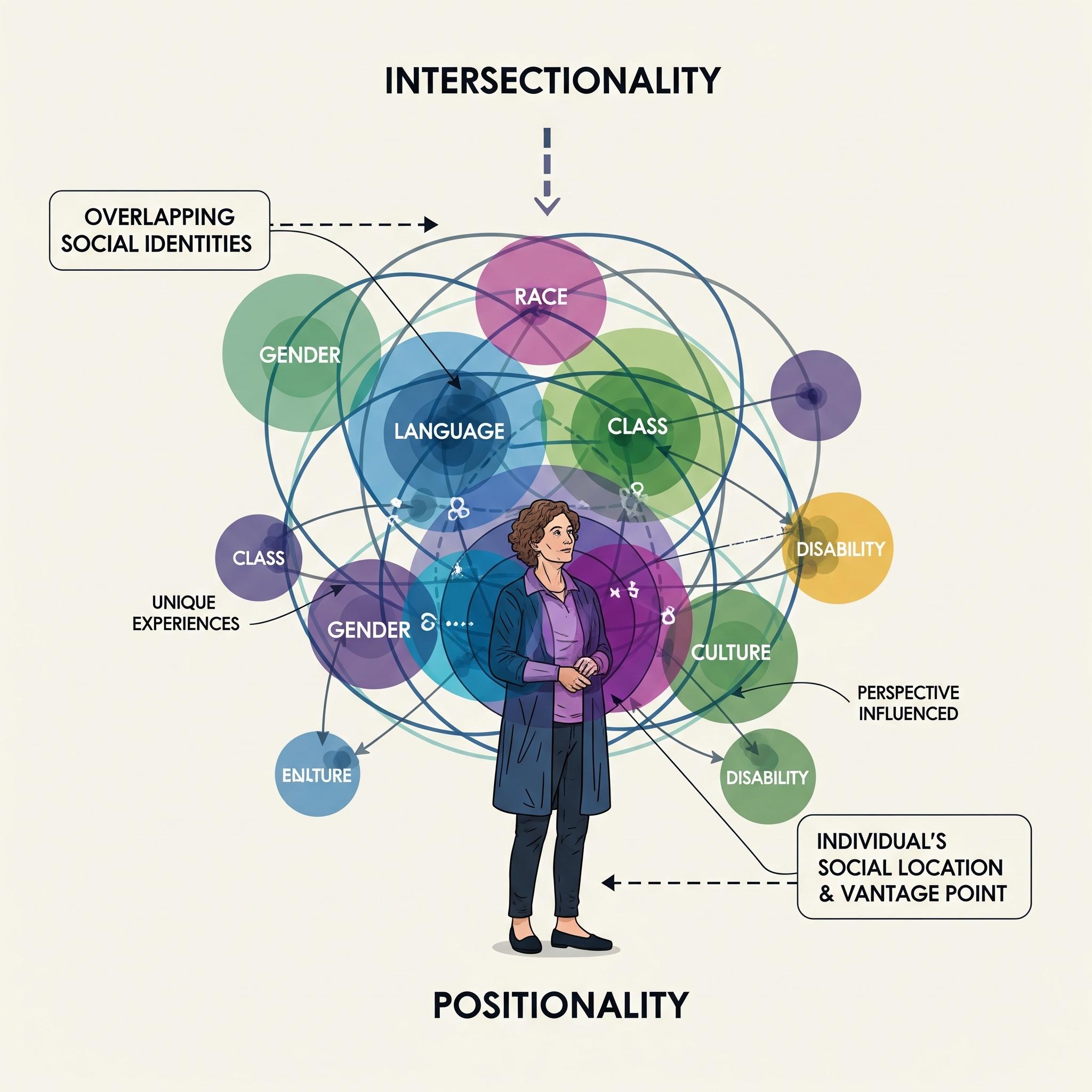
A well-resourced school can offer academic help without every student experiencing that help as accessible, respectful, or supportive of belonging. Students’ race, neurodiversity, language, class, and other dimensions of identity may shape how expectations and interventions are encountered. Those intersections need to be understood rather than reduced to a single label or score.
My draft describes questions arising from the Learning Engagement Center (LEC) and Read/Write support classes: what academic support makes possible, how students understand placement, and whether the language surrounding support can create stigma. These are observations motivating research, not systematically collected findings or conclusions about an intervention’s effectiveness.
The developing purpose is to examine students’ academic and belonging experiences alongside available, authorized MAP growth evidence, asking what the school can learn about its support systems. I am interested in how neurodiversity and sense of belonging may influence achievement. That interest is a research question—not a demonstrated causal relationship.
Belonging is not something students must earn. The community brings belonging to them and lives it, including older students welcoming and modeling it for younger students. BIPOC students, families, and colleagues are the school, not visitors to it.
03
Working research questions
These are proposed revisions that bring the paper’s strands together, not a final approved protocol or a verbatim list from the draft:
- How do neurodivergent BIPOC students describe belonging and their academic experiences within this private school community?
- How do students describe the supports, relationships, expectations, and barriers that shape their participation and learning, including experiences of LEC or Read/Write support where relevant?
- What patterns of MAP growth over time can be described in the authorized records of the students included in the study?
- How do students’ counterstories illuminate, complicate, or differ from the patterns visible in MAP growth data?
A question for my professor: should the study remain centered specifically on neurodivergent BIPOC students, or include the broader support-identified student population discussed in the paper? The answer determines recruitment, any comparisons, and what the findings can responsibly claim.
04
Conceptual framework and literature
Intersectionality and neurodiversity
Intersectionality keeps race and neurodiversity from becoming separate boxes. Critical disability and neurodiversity perspectives ask how the learning environment, definitions of competence, and access to support shape students’ experiences. Armstrong’s neurodiversity work and the disability-justice sources on my Reading page help me examine strengths and environmental barriers without diagnosing participants or treating difference as deficiency.
Belonging, culturally relevant teaching, and achievement
Goodenow’s school-membership work and the belonging literature, including Uwah and colleagues, help frame the relationship between students’ sense of membership and academic life. They do not establish what happens at my school. Ladson-Billings’ The Dreamkeepers and culturally relevant pedagogy hold academic success, cultural competence, and critical consciousness together. They offer a way to ask about achievement without separating it from community or reducing it to a test score.
Educational equity asks whether students receive what they need, not simply whether everyone receives the same thing (Barth, 2016). Support should make learning possible without positioning the students who use it as less fully members of the school.
Counterstorytelling and researcher positionality
Critical race theory is one essential frame for examining structures and whose accounts are heard. Counterstorytelling creates space for experiences that dominant institutional accounts may overlook. Narrative inquiry attends to those accounts in their context and over time; it is not interchangeable with simply collecting quotations.
H. Richard Milner IV’s framework for race and researcher positionality (2007) keeps my role visible: researching the self, the self in relation to others, reflection and representation, and the shift from self to system. Kumashiro’s work asks me to examine what familiar practices make difficult to notice. Both matter when the researcher is also a teacher inside the institution.
Racialized rigor as a supporting concept
I use racialized rigor as a working term for differential demands accompanied by less flexibility or grace, sometimes described as preparation. Within this revised proposal, it is a possible lens for examining students’ accounts of expectations and support—not a finding, a proven mechanism, or a condition every participant is presumed to experience. I still need to investigate the term’s prior use before claiming novelty.
The discipline and opportunity-gap literature—Skiba, Milner and Laughter, and Carter and Welner—provides context for examining discretion and access. It does not establish that the same patterns occur here. The more focused review will bring belonging, neurodiversity, counterstorytelling, and academic growth into dialogue rather than keeping racialized rigor at the center of every strand.
The blueprint of belonging framework · The literature review and APA sources · Methodological thinking
05
Developing methodology: accounts alongside growth data
Design decision. The draft points toward a narrative-led study with a quantitative MAP growth strand. If both strands are retained and deliberately integrated, a mixed-methods design may be appropriate. The sequence, weighting, and integration procedure need to be specified with my professor; merely adding scores to interviews would not resolve that design question.
Participants and boundaries. The focal direction is neurodivergent BIPOC students at a private high school. The paper also discusses a broader group of students receiving support and mentions recent graduates. Eligibility, the role of graduates, recruitment, sample size, and whether families or staff participate remain to be finalized. Support placement is not, by itself, a diagnosis or a definition of neurodivergence.
Student narratives
My current preference is hybrid interviews: participants choose written asynchronous responses or a spoken interview, using the same core questions. Written participation does not require a spoken component. Follow-up should respect the participant’s chosen format. The protocol still needs to define prompts, timing, accessibility, and how the different formats will be analyzed.
Topics may include feeling welcomed, relationships, expectations, support, asking for help, and students’ own understandings of their academic progress. Counterstorytelling requires attention to context, representation, and whose interpretations receive authority; it should not become a requirement for students to narrate harm.
MAP growth data
The paper names MAP growth over time but does not yet specify the years, testing intervals, subjects, eligible records, or analysis. The next draft needs a data-access plan and a definition of growth before selecting comparisons or procedures.
- Identify which existing MAP records are available and authorized for research use, and whether they can be linked to participants’ accounts under an approved plan.
- Specify testing windows, score fields, comparable observations, and how missing records or differences in testing conditions will be handled.
- Explain what descriptive patterns can be examined and whether the sample and measures support any further analysis.
- Describe how support participation will be understood without assuming placement was random or that growth demonstrates intervention effectiveness.
MAP is one source of evidence about measured academic growth, not the whole of achievement, student potential, or belonging. Any claim that belonging influences scores would need a design capable of supporting it. Students’ accounts and descriptive growth patterns alone cannot establish causation.
Analysis and integration
The proposed narrative work would examine accounts in context, with an explicit analytic approach still to be selected. The quantitative strand would describe the authorized growth records. An integration plan could place relevant narrative themes alongside growth patterns, asking where the strands converge, diverge, or leave questions unanswered—without treating scores as a test of whether a student’s story is true.
A researcher decision log and reflexive journal can document my interpretations and choices. They support the study’s transparency; they are no longer a single classroom task’s “countable spine.” Participant review of representations and an appropriately situated critical reader are options to discuss as part of trustworthiness.
06
Positionality and community responsibility
I am a white teacher studying an institution where I work. My familiarity may help me notice questions, but it can also make assumptions invisible. My role carries authority, including the possibility that students may feel pressure to participate or soften what they say.
Studying neurodiversity through my child’s testing has prompted recognition of some shared ADHD and autism characteristics; that is personal reflection, not an official diagnosis. It does not make my experience interchangeable with the experiences of neurodivergent BIPOC students. I need to listen without making my own story the measure of theirs.
Our high school campus remains largely white. My working estimate is that about 5–7% of teachers are BIPOC—not an official workforce report. We have work to do, and we need representation at all levels. That context motivates inquiry; it should not be confused with a finding from this proposed study.
07
Ethics, permissions, and limits
The first draft does not yet contain a completed ethics or methods section. IRB approval and any required school permissions must precede research recruitment, participant interviews, and access to identifiable student records for this study. Existing teaching access is not automatically research permission.
The next draft must specify consent and, where applicable, student assent and guardian permission; voluntary participation without academic consequences; who recruits and interviews; how my teacher role is separated from the research; and who can access identifiable records. Hybrid interviews also require a plan for written-response storage, spoken recording consent, and secure handling.
A pseudonym for the school is not enough to ensure anonymity. Small groups and intersections of identity can make students recognizable even without names. The plan needs safeguards for linking narratives with MAP records, suppressing identifiable details, reporting small-group results, retaining data, and allowing withdrawal. Confidentiality has limits; it should never be promised as absolute.
A single-school study can offer situated insight, not establish prevalence across private schools. Selection into academic support, missing records, differences in testing conditions, the interview format, and my relationships with students may all affect interpretation. Findings must make those boundaries visible.
08
First-draft artifacts: the paper and presentation
These artifacts preserve the proposal as it stood when I presented it. The shorter page title above is a working summary, not a claim that the dissertation title has been finalized.
First draft on paper · EDOC 7120
A counterstorytelling analysis of neurodivergent BIPOC students’ academic and belonging experiences, with narrative inquiry and a proposed examination of MAP growth data. The submitted paper preserves unresolved design choices and sections still to come.
Presentation · first draft · October 17, 2026
Counterstorytelling, belonging, and achievement
My recorded research proposal presentation, alongside the written first draft. A working direction, not a completed study. About 22 minutes.
Open the recording separately09
A provisional chapter plan
- Introduction: school context, problem, purpose, focal population, belonging and achievement, and the finalized research questions.
- Literature review: intersectionality, neurodiversity, belonging, culturally relevant teaching, academic support and growth, and counterstorytelling. Racialized rigor remains a supporting lens.
- Methodology: the selected design, participant eligibility, hybrid interview protocol, authorized MAP records, analysis and integration, positionality, and ethics.
- Findings: student accounts and, if retained, MAP growth patterns, with an explicit account of how the two strands are read together.
- Discussion: implications for equitable support and community belonging, warranted interpretations of achievement, limitations, and remaining questions — including the first draft of a blueprint of belonging: what the students’ accounts and growth patterns suggest a predominantly white private school would need to build in order to welcome, support, scaffold, and retain the students it has historically placed outside the bubble of normalcy.
Possible appendices include the interview protocol, recruitment and consent materials, data-access and confidentiality plan, and analytic decision log. None is presented here as approved.
10
What the next draft needs
- Reconcile the title versions and settle the focal population with my professor.
- Choose and justify narrative inquiry alone or an integrated mixed-methods design.
- Confirm what MAP records could be authorized and specify the longitudinal growth plan.
- Define belonging and achievement carefully and align each question with evidence and analysis.
- Complete the hybrid interview protocol, teacher-researcher safeguards, and IRB materials before research data collection.
The goal is not to force students’ lives into one explanation. It is to understand what their experiences and available growth evidence can teach the school about belonging, support, and the conditions for learning — and to assemble what is learned into a blueprint of belonging the school could actually build from.