Researcher positionality
Where I stand, what I carry, and what I cannot claim
An honest statement about studying racialized rigor as a white, middle-aged, married, highly educated woman who has also known real harm, real silence, and real debt.
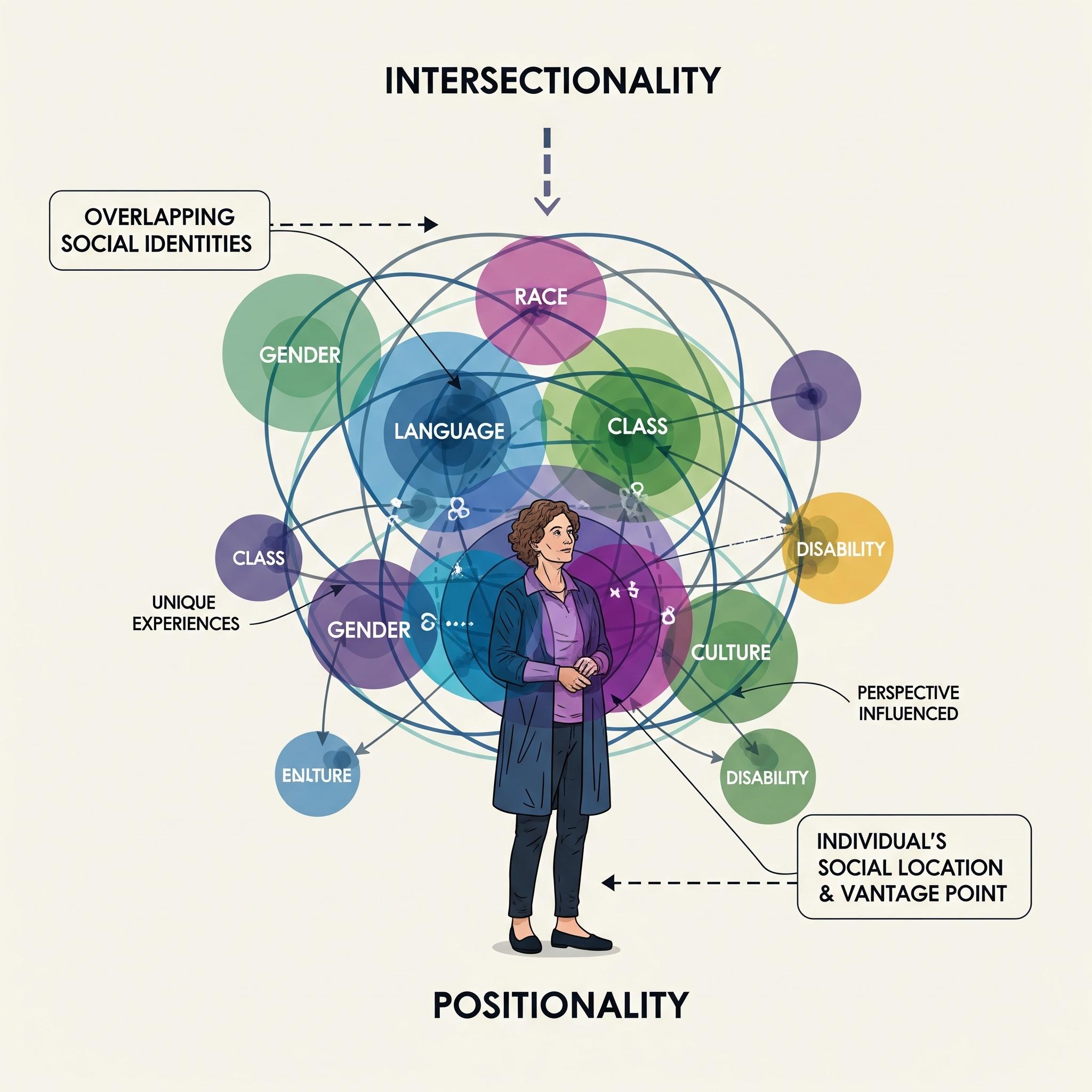
Identity markers
White, middle-aged, cisgender woman. Married twenty-nine years. First-generation college graduate. Twenty-five years in public and private school classrooms.
Hardships that shape me
Sexual assault, abuse, divorce, poverty, an absent and harmful father, and eighty thousand dollars of student debt. I found my voice after forty, really after fifty.
What I do not experience
Systemic racism. I have not been followed in a store, denied a loan because of my race, or suspended at higher rates for the same behavior. That absence matters.
01
The honest question
I asked this out loud because I mean it: where do I, a white woman, fit into intersectionality? My life has not been easy, but not because of my skin color. That distinction is the whole point.
Intersectionality is not a competition over who has suffered most. It is a way of seeing how systems of power overlap — race, gender, class, ability, sexuality, and more. I am in that diagram on several axes. I am a woman who was socialized to cook and listen, who learned to swallow her own observations before they became inconvenient, who did not find her voice until after forty and not fully until after fifty. I am someone who lived in poverty as a child, whose father walked out and stayed out, whose stepfather’s small Navy pension was the difference between stability and continued scarcity. I am still paying, in memory and reflex, for the years when money was tight and safety was tighter.
But I am also white. And that whiteness means the hardest things I survived were not caused by racism. They were caused by misogyny, by intimate violence, by economic precarity, by family rupture. Real harms. Real systems. Not the same system.
02
What I carry
I carry the memory of being a college student who had been assaulted and still had to sit in class and perform normal. I carry the memory of being in graduate school and realizing, too late, that the person I trusted was not safe. I carry the reflex to soften my own sentences, to add a smile, to make myself smaller before someone else decides I am too much.
I carry class anxiety. Even now, with a graduate degree and a career, I can feel the old fear that I do not belong in a room. The debt I graduated with — eighty thousand dollars — taught me that education could be both a door and a weight. I paid it off, but I did not forget what it cost.
These experiences give me empathy. They also give me a particular kind of authority. I know what it means to be silenced, to be underestimated, to be asked to perform gratitude for crumbs. That knowing helps me ask better questions about students who are being asked to perform the same things for different reasons.
03
What I do not carry
I do not carry the daily, structural weight of racism. I have not had to teach my children how to talk to police. I have not been the only person of my race in a meeting and felt the burden of representing a whole group. I have not been denied opportunities because someone could not see past my skin. When I walk into a school building, my whiteness is read as neutral, professional, expected.
This matters for my research because racialized rigor is specifically about race. It is about how students of the global majority are pushed harder, punished faster, and forgiven less, all while adults describe the arrangement as preparation. I can see the pattern because I have watched it for twenty-five years. But I cannot claim to know it from the inside. My job is not to speak for students of color; it is to create conditions where their own accounts of the classroom are centered, and where my own practice is the first thing I interrogate.
04
How this shapes my research
My dissertation asks a perception-gap question: what do teachers believe they are offering students of the global majority, and what do those students experience as actually available? I am the teacher in that question. I am also the researcher who has to keep checking whether what I think I see is what is actually happening.
H. Richard Milner IV writes that race-focused researchers must move from researching the self, to researching the self in relation to others, to shifting from the self to the system. I take that seriously. My own story of silence and survival helps me notice when students are being quieted. My whiteness means I have to work harder to notice when the silencing is racialized.
I will get this wrong sometimes. Positionality is not a box to check; it is a posture to keep returning to. This statement is a living document because I am still learning what I can see and what I cannot.
05
What I was never taught
I grew up learning a civil rights movement with a cast of about two: Martin Luther King Jr., and Rosa Parks as a sweet little old lady whose feet were tired. It took me decades to learn the fuller story — that Parks was a trained nonviolent organizer with the NAACP, that Fannie Lou Hamer testified at the 1964 Democratic convention about being beaten for trying to register to vote, and that Bayard Rustin, the architect of the March on Washington and, in Aldon Morris’s telling, the most brilliant tactician of the movement, could not be its face because he was gay. He built the stage and was kept off it.
Reading Melinda D. Anderson on how schools teach a cleaned-up version of the movement, and Morris on how it actually worked — strategic, organized, disciplined, planned — I had to sit with what my whiteness did to my education. It did not have to ban the history. It just curated a comfortable version of it and called it complete. I am a white woman who grew up knowing very few of the main leaders, in schools that did not seem to notice what they had left out. I am not responsible for the textbook I was handed. I am responsible for the one I hand my students.
And Rustin is the one who keeps teaching me what intersectionality actually costs and actually offers. He lived at the crossing of multiple oppressions — a Black gay Quaker pacifist, distrusted by parts of the very movement he was organizing — and had to figure out a way to lead through all of it. The movement moved him behind the scenes; he became the most organized person in the room. Intersectionality is usually taught as a lens for naming burdens. Rustin shows the other half: what it takes to lead from inside the crossing, when no single box was ever going to hold you.
I am also learning how theories of “collective behavior” once described protest crowds as irrational, emotional, savage — without plan. I can see what that framing accomplishes: a crowd described as a mob can be managed instead of heard. The history says the opposite. Whoever controls the description of the crowd controls the response to the crowd — and in a classroom, whoever controls the description of a student controls the response to the student. That is the same muscle my research studies.
That insight changes the curriculum I hand students. I have often begun with the most recognizable leaders and the most violent images, intending to show courage and injustice. I now have to ask what that sequence leaves students believing about agency. If organizers appear mainly as icons or suffering bodies, while planning, fundraising, institutions, argument, care, and persistence stay offstage, then my good intentions can still reproduce the story I mean to challenge. My positionality lives in those editorial choices — especially the first image, first name, and first question of a unit.
06
Commitments
I commit to naming my own racial privilege without defensiveness. I commit to holding my gendered and class-based wounds as real, but not as equivalent to racism. I commit to listening more than I speak when students of the global majority are describing their own school experiences. I commit to making my classroom and my research sites places where the hardest feedback is welcomed, not punished.
And I commit to staying in the question. The point of intersectionality is not to find a tidy label for myself. The point is to keep looking honestly at how power moves through a room — including the rooms I am in charge of.
07
Why I study neurodiversity
My interest in neurodiversity is personal as well as scholarly. I have a neurodiverse child, and learning alongside them through testing made me recognize that I share many characteristics associated with ADHD and autism.
That recognition is not an official diagnosis, and I do not present it as one. It has, however, made me more attentive to the many ways people think, communicate, learn, and experience a classroom. It also reminds me not to mistake one familiar way of learning for the only capable or rigorous one.
Studying neurodiversity helps me examine the assumptions schools make about attention, participation, organization, and belonging. My child’s experience brought me to these questions; the scholarship helps me ask them with greater care.
08
From listener to learner to leader
I grew up inside a family script in which women cooked and listened while men ate and talked. A visit with relatives in California in 1993 showed me a different table: women and men speaking, interrupting, laughing, and taking up space equally. I did not yet have Mezirow’s language for a transformed frame of reference, but I had encountered a way of being that made my inherited pattern visible.
My path from listener to learner to leader is not a rejection of listening. It is a refusal to confuse listening with disappearance. Belenky and her colleagues, bell hooks, Mezirow, and Cranton help me understand voice as something shaped by family, gender, education, dialogue, and the gradual revision of what a person believes is possible.
Belonging complicates that transformation. I often feel a beat outside a group’s conversational rhythm, trying to weave myself into a pattern that closes again. That experience is real, but it is not equivalent to racism or to the racialized and gendered exclusion Joy Buolamwini describes. Holding that distinction helps me study belonging without turning my own discomfort into a claim on someone else’s experience.
These reflections shape the questions I bring to schools: who must change themselves to enter the conversation, whose presence is treated as ordinary, and whether leadership can make room without requiring a person to master an unwritten social rhythm first.
09
Fairness, equity, and the school I work in
My whole career has been about growing in my understanding of fairness versus equity. For most of it I used the two words almost interchangeably. Fair treatment is not necessarily equitable treatment: equality is achieved when students are treated the same and have access to similar resources, while equity is achieved when each student receives what they need to graduate prepared for the life that follows. All students deserve what they need in order to build the lives that they all deserve, and what students need is not the same amount of the same thing.
That idea came out of the civil rights movement — from a court that declared education a right which must be made available to all on equal terms, and from enforcement agencies whose language is still written in the image of open doors. I read that history carefully because it locates my own instinct: access is the floor of equity, not the finish. The federal accountability machinery that grew out of it, including ESSA’s requirement to report results by subgroup, attaches to public schools. Most independent schools sit outside it. In the school where I teach, nobody is required to count anything.
So the part of equity I can practice is the scaffold — what I add before the task so a student can actually meet it: the paragraph written in front of them, the extra week, the example in their language, the permission to try it badly first. A scaffold is not a lowered standard. And it has to be assigned by need rather than by my guess about a child, because a scaffold given on a guess is a micro-assumption with a nicer name, and the same guess running the other way is what I have been calling racialized rigor.
I want to grow in my understanding of educational equity and in how it pertains to the elite school where I teach — a school whose student body has changed faster than its habits. The version of equity I am after costs something: it asks who gets into the advanced course, who is offered the extension, who is quietly asked to prove they belong, and what we would be willing to count in order to know. What I have to give up is the comfort of being even-handed.
Read “Fair is not the same as equitable” →
Read the educational equity strand →
10
We are the community sitting in this room
I want our BIPOC community members to feel that they are the school — not visiting it, not standing outside some old bubble that used to hold it. We are the community sitting in this room, and we are beautifully diverse, and that is what makes us beautiful.
I put that in a positionality statement because it is a claim about my own classroom, not a description of anyone else’s feelings. The belonging literature gives me the reason to be exact about it. Baumeister and Leary treat belonging as a fundamental motivation rather than a climate nicety; Osterman shows that adult behavior is one of the main things that decides whether a student feels part of a school community; Walton and Cohen show that doubt about fit can hold achievement down all by itself. If those findings hold, then a student who is present but positioned as a guest is not having a smaller version of the same schooling. They are having different schooling.
So the part of this that belongs to me is structural, not sentimental. Being the school means being in the rooms where the course is approved, the policy is written, the family is called before there is a problem, and the success is claimed. I have been in those rooms longer and more comfortably than most of the BIPOC colleagues and families connected to my school. That makes it my job to notice who is treated as a host and who is treated as a guest — and to say so when the difference shows up in something as small as a name read wrong, or a celebration of diversity that happens once a year.
The version of this I actually hold myself to is narrower and harder: I want all students to feel they belong the moment they get here. Not after they have proved they can handle the work, not after they have learned how the place runs. The first morning. And I do not think belonging is something a student earns at all. It is up to the community to embrace you and bring the belonging to you — not the other way around. The community lives belonging: the older students are its role models for the younger ones, and the younger students do not earn it — they arrive inside a practice that is already underway. That makes arrival a design question rather than a wish, because somebody decides what the first hour looks like — whose name is read correctly, who is greeted in a hallway, which students are asked to speak as experts on their own lives and which are simply asked to keep up. A student who is made to feel a guest in the first week spends the rest of the year catching up to a belonging their enrollment already granted them.
The numbers at my own school are why this is not abstract for me. Our high school campus is still largely white, and by my working count only about five to seven percent of our teachers are BIPOC. I hold those figures loosely — they are my estimate, not an official report, and that is part of the point: nobody is required to publish them. But even held loosely, they say the same thing clearly. We have work to do. A student body that is changing faster than the faculty means more and more students who can go a whole career at our school without once being taught by someone who shares their background — and a community that wants to live belonging has to be honest about who is doing the living.
We need representation at all levels. The classroom is where a student first looks, but it is not the only place they look, and it is not where the decisions get made. The counseling office, the front office, the coaching staff, the divisional and upper leadership, the board of trustees, the committees that hire and the families who sit on them — a student reads all of it, whether or not anyone has put it in a report. If the people who approve a course, write a policy, extend an offer, or call a family home all look alike, then the message about who belongs here arrives without anyone having to say it out loud. Representation at every level is not a number we would like to improve. It is part of what makes the earlier sentence true: we are the school, not some of us visiting it.
Underneath all of this, for me, is something I would say in morning chapel before I would say it in a dissertation: belonging is a quality of God. Living the quality of welcoming others is what makes others feel they belong, and that is expressing Love the way God expresses love — outward, first, unearned. Love is a living verb; it only exists in the doing of it. The research uses the language of belonging theory. Chapel gets the truer sentence.
And because I am a builder as much as a believer, I have given the constructive half of this a name: a blueprint of belonging. If the dissertation documents where belonging fails, the blueprint is what the findings are for — a buildable plan for how a predominantly white school welcomes, supports, scaffolds, and retains its BIPOC and marginalized students, including neurodivergent students and students pushed outside the bubble of normalcy for gender identity or any other reason. A blueprint is not a wish; it is a drawing with measurements, checkable against the actual building. That is the standard I want my work held to.
Read “The Dreamkeepers, and the teachers I want to learn from” →
Read “Morning chapel: belonging as a quality of God” →
Read “Naming the destination: the blueprint of belonging” →
Read the belonging strand of the literature review →