The undercurrent: executive function skills
My main focus at work right now is executive function skills — the foundational skills underneath all of life's activities, not just schoolwork. I study systems, and EF is a system we have to scaffold for our students in LEC workshop — until they can build systems of their own.
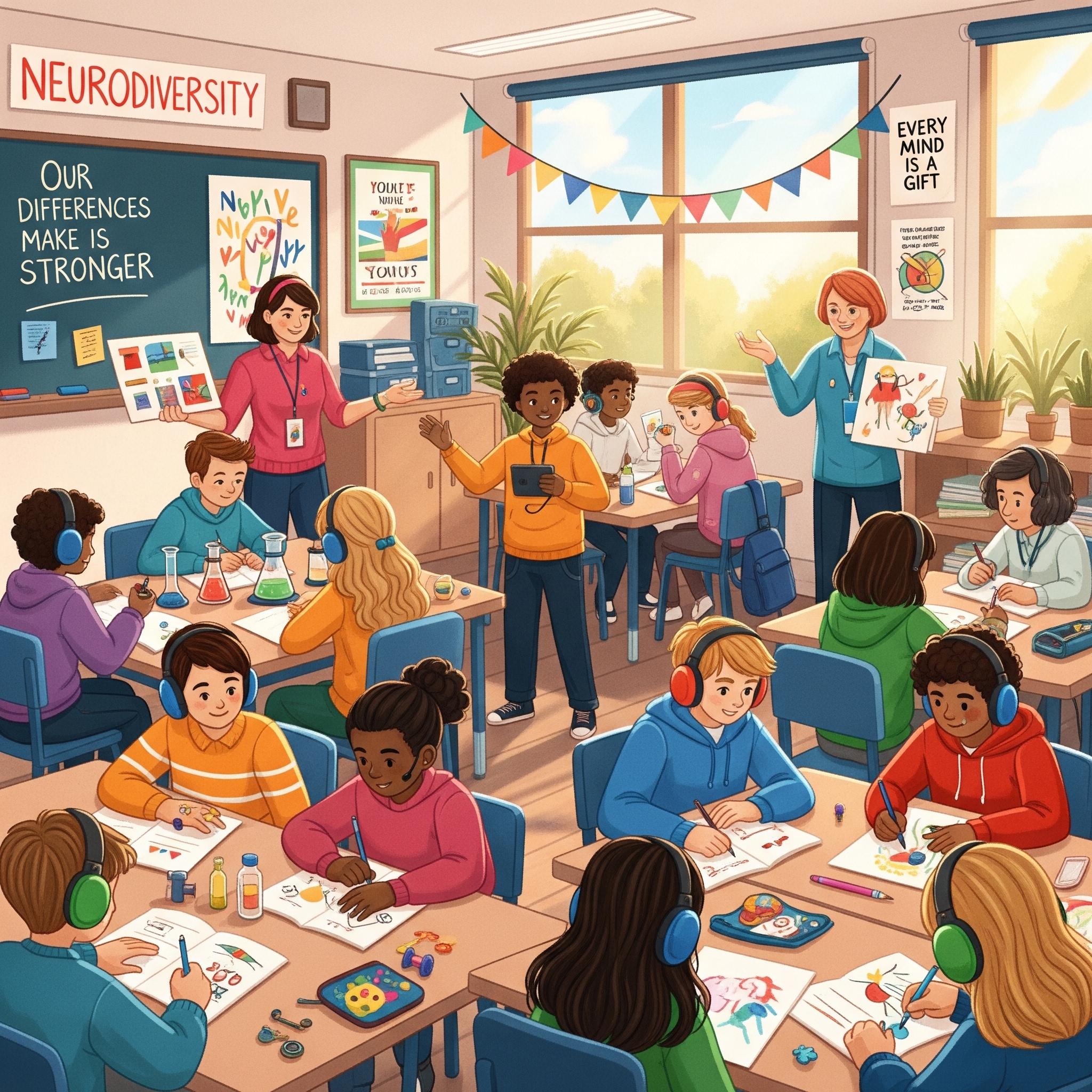
My main focus at work right now is executive function skills. The framework I am working from is Emily Bartz's — a learning specialist at Friends School of Baltimore whose approach is grounded in Peg Dawson and Richard Guare's executive skills research. Her premise is the one I have built my practice on: EF is not a program to implement. It is a shared lens — a way of reading student behavior as skill development in context rather than as character. She calls it putting on your perspecticules: perspective plus spectacles. Once you wear them, the student who looks lazy becomes a student whose task initiation is underwater, and the student who looks careless becomes a student whose working memory dropped the second step.
The reason this focus has taken over my work is that EF skills are foundational to all of life's activities, not just school. Starting, planning, organizing, holding information in mind, managing time, shifting approach, regulating emotion, finishing — that is the machinery under keeping a job, a friendship, a household, a promise to yourself. School just happens to be the place where the machinery gets tested eight periods a day. A student can understand the material completely and still not be able to get the essay started, find the worksheet, or feel the deadline coming. The gap between understanding and execution is the central frustration of school for so many of my students, and treating that gap as a character flaw is one of the quiet cruelties of schooling.
I study systems — that is how my mind works — and executive function is a system. Not a trait, not a talent, but an interlocking set of processes that either holds a student's day together or doesn't. And because it is a system, it can be scaffolded like one: deliberately, structurally, with the scaffold designed to come down. You do not fix a system by telling it to try harder. You find where the friction actually is — the start, the middle, the handoff between steps — and you build structure at exactly that point.
LEC workshop — our supervised study skills class and study hall — is where the scaffolding happens. The scaffolding is the curriculum: we are not only getting tonight's homework done, we are building the executive function system that tonight's homework happens to be exercising. A supervised study hall can be a place where students are parked, or it can be the one hour in the day where someone is deliberately teaching the skills every other hour assumes. I want it to be the second thing.
And the goal is handover. Students need to develop their own systems for managing their EF skills — not my system laminated and handed down, but theirs: the planner they will actually open, the starting ritual that works for their brain, the way of breaking a project into pieces that they arrived at themselves. A scaffold that never comes down is a dependency with good intentions. What I want a student to carry out of LEC is not a finished system but the knowledge that they are a person who builds systems. That sentence, believed, is worth more than any planner I could hand them.