From "othered" to included: the words came before the science
Neurodivergence and neurodiversity are not two names for the same thing. One asks what is wrong with this person. The other asks what is wrong with the room.
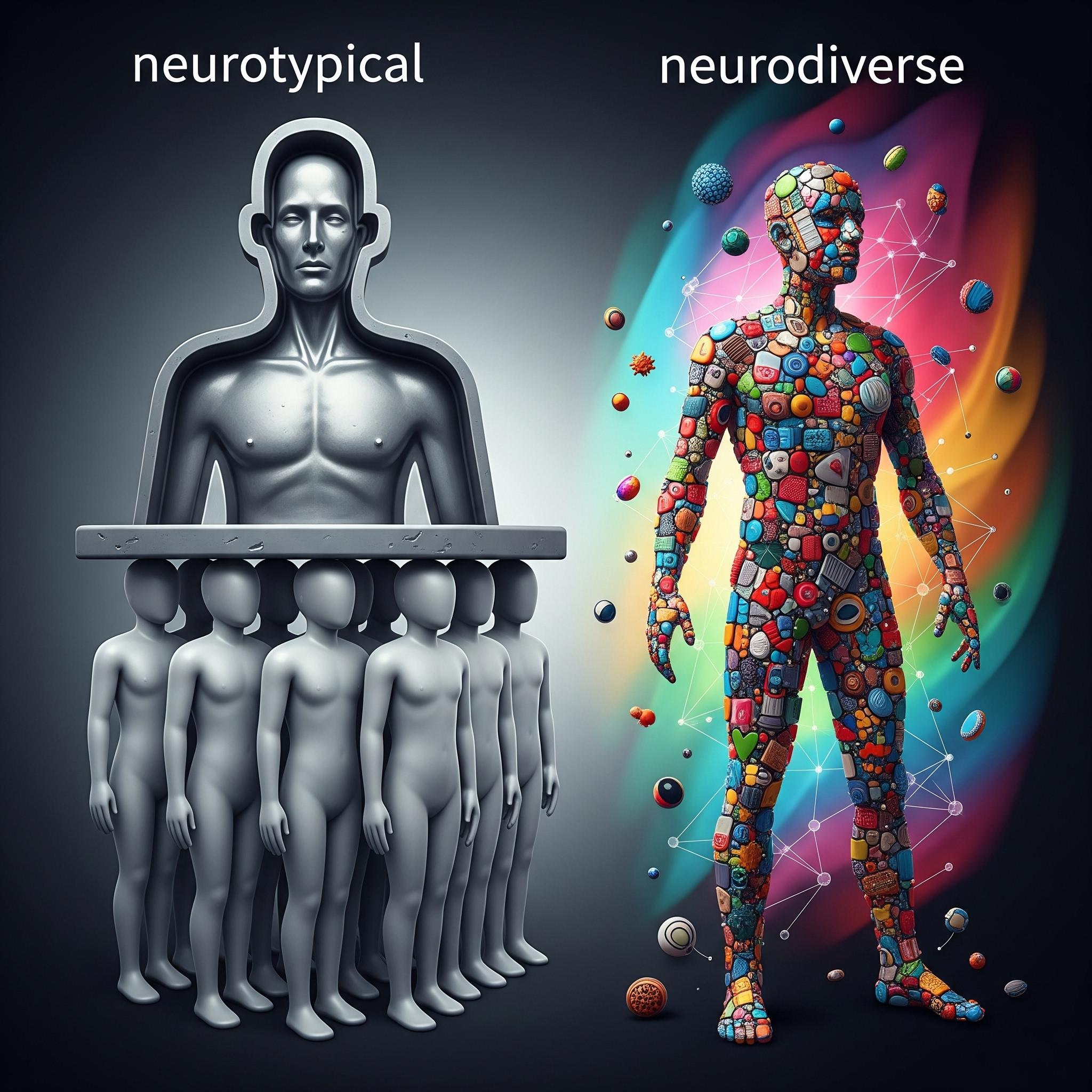
I started the Week 6 presentation thinking I was assembling a history of autism. What I actually assembled was a history of judgment — and it began with two words that are not interchangeable.
Neurodivergent was coined to describe an individual whose cognitive functions are deemed outside of the "normal" or "typical" behavior of the dominant cultural norms of a society. Kassiane Asasumasu, an activist from Portland, Oregon, coined it in the 2000s to explain that — as Nick Walker puts it — "within the spectrum of neurodiversity, there are dominant norms and divergences from the dominant norms."
Neurodiversity, coined in the late 90s, denotes in my experience a more additive perspective: the capacity of the human brain to vary naturally, and a movement toward accepting those variations as multiple forms of normal — a normal part of human biodiversity.
The question I kept writing in the margins: how can we recognize the complex layers of a person's needs without reading those layers as a deficit? Or, more bluntly — how do we celebrate rather than other?
Evolution of thinking · revisited
What I thought then
Neurodiversity was a kinder vocabulary for the same clinical category — a matter of tone.
What I think now
It is a political claim. Changing the noun changes who is being asked to change: the student, or the institution.
What changed my thinking
Tracing the word from Asasumasu to Blume to Singer and realizing it was coined by advocates, not by clinicians.